Wakes and blockage
Wake and blockage losses are the production losses caused by the wind speed deficit downstream of the turbines and by the reduction of wind speed upstream of them. Tipspeed computes these losses on 10-minute time series, with the wake model best suited to each site, tuned on operational data.
Wake and blockage models
Wake and blockage losses are evaluated on 10-minute time series over the analysis period with PyWake (Pedersen et al., 2019). Three engineering wake models are available:
- the TurbOPark Gaussian model (Nygaard et al., 2020);
- the Park2 model (Rathmann et al., 2018);
- the Zong Gaussian model (Zong & Porté-Agel, 2020).
Wind farm and turbine blockage is modelled by combining the wake deficit model with the scaled Rathmann blockage model (Meyer Forsting et al., 2021). Wake-induced turbulence is modelled with the Crespo–Hernández model (Crespo & Hernández, 1996).
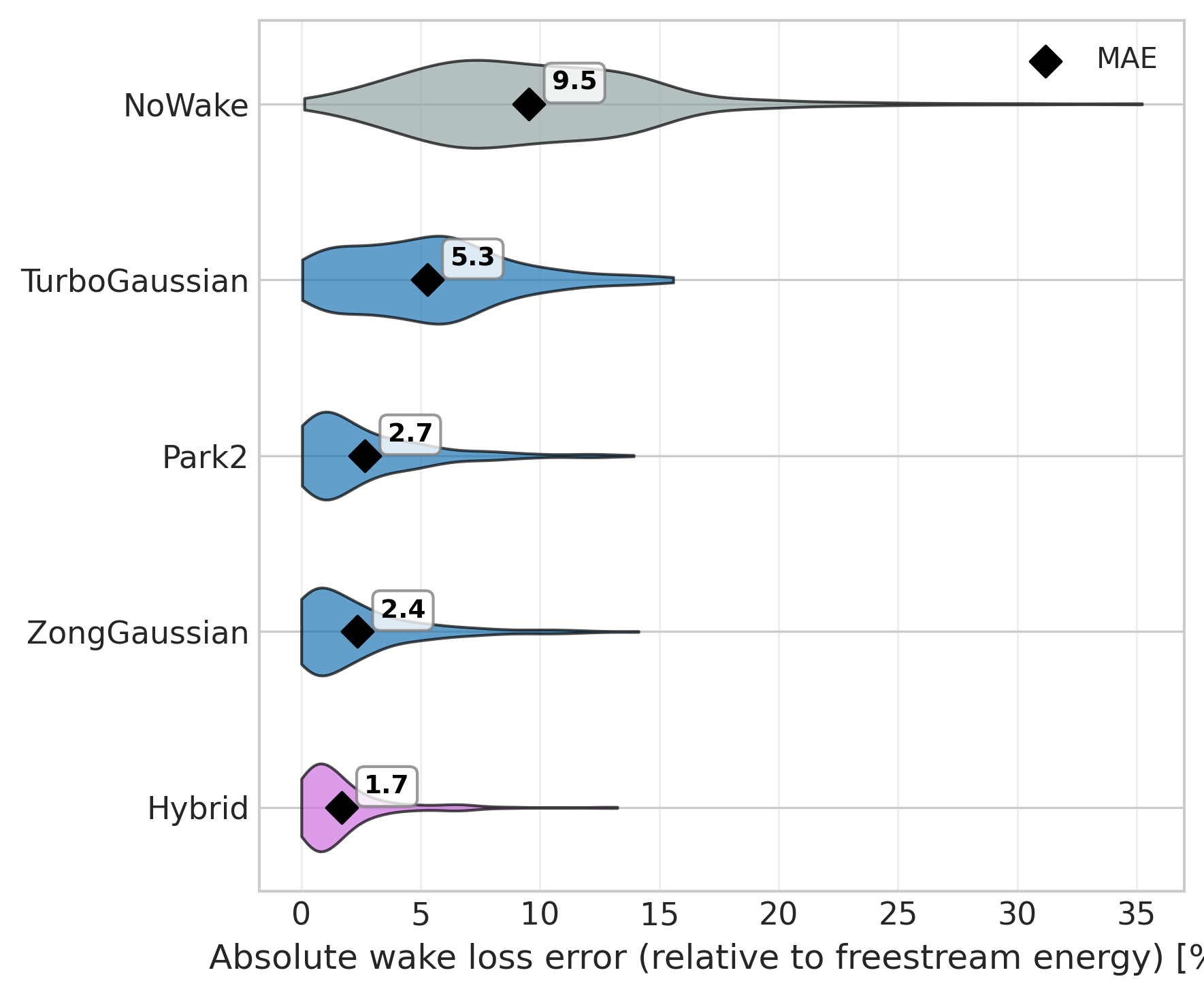
Tipspeed benchmarks the wake models on operational data from nine wind farms (Davoust & Delaunay, 2026). This benchmark is the basis for selecting the model for each site. The selected model is then tuned on operational data, as described below. This is the method used in delivered analyses.
Wake model parameter tuning
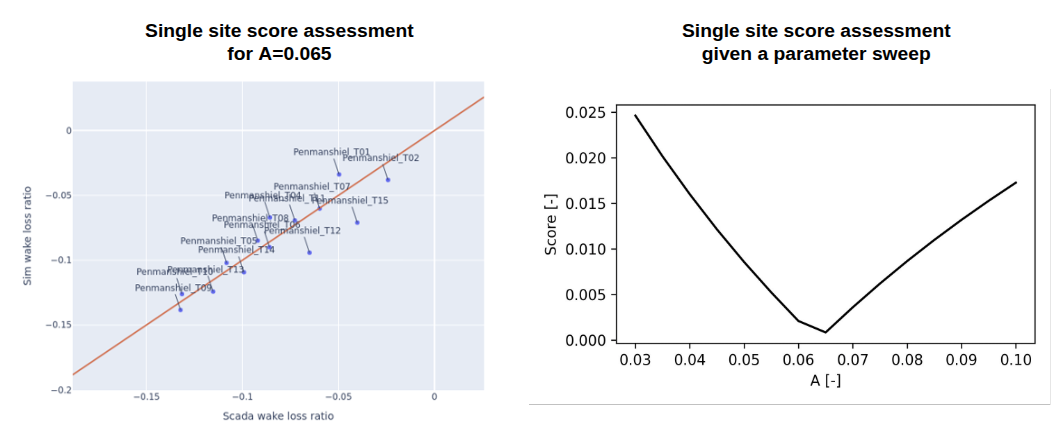
Wake model parameters are optimised for each site on operational data. The optimisation minimises, for each turbine, the error between:
- the wake efficiency measured from SCADA data, referenced to the turbines that the simulation identifies as least waked in each direction sector;
- the wake efficiency predicted by the digital twin.
The optimum is selected by grid search over the parameter space (Davoust & Delaunay, 2025b).
Hybrid wake modelling (research)
Tipspeed is also researching a hybrid wake model. The model uses machine learning to weight several engineering wake models so that their combination best represents the observed wake losses. The benchmark above indicates that it outperforms any single model. It is a research topic and not part of the delivered analyses: delivered results use the single wake model tuned for each site, as described above.
The method was presented at the WindEurope Annual Conference 2026 and at TORQUE 2026 (Davoust & Delaunay, 2026).